

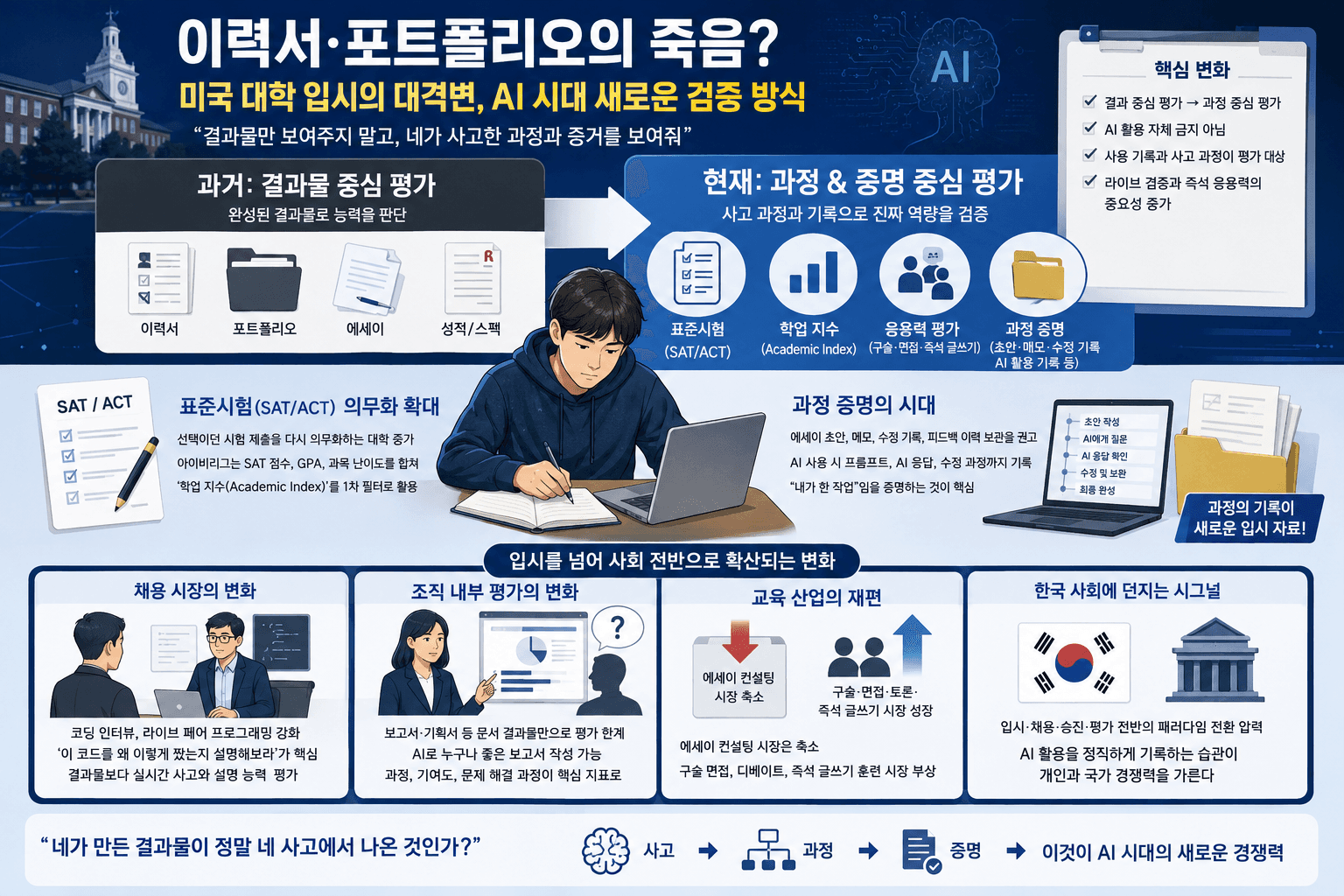
미국 대학 입시의 대격변, 그리고 AI 시대의 새로운 검증 방식
[미국] | US Corean
미국 주요 대학들의 입시 방향이 빠르게 바뀌고 있다. 핵심은 단순하다.
“결과물만 제출하지 말고, 그것이 정말 네 생각과 과정에서 나온 것인지 증명하라.”
최근 미국 대학 입시에서는 SAT·ACT 같은 표준시험의 비중이 다시 강화되고 있다. 코로나 이후 시험 선택(Optional) 정책을 유지하던 대학들조차 다시 시험 제출을 요구하기 시작했다. 아이비리그 일부 대학들은 SAT 점수, GPA, 과목 난이도를 조합한 ‘Academic Index(학업 지수)’ 기반 평가를 강화하는 흐름도 보이고 있다.
반면 AI로 대량 생성이 가능한 에세이와 포트폴리오의 신뢰도는 빠르게 흔들리고 있다. 완성된 결과물만으로는 학생의 실제 능력을 판단하기 어려워졌기 때문이다.
중요한 변화는 “AI를 쓰지 마라”가 아니다.
오히려 “AI를 어떻게 사용했고, 어떤 사고 과정을 거쳐 결과물을 만들었는가”가 새로운 평가 대상이 되고 있다는 점이다.
일부 미국 교육 컨설팅 업계에 따르면 상위권 대학들은 학생들에게 에세이 초안, 메모, 수정 기록, 피드백 과정 등을 보관하도록 권고하기 시작했다. 단순히 완성본만 제출하는 것이 아니라, 사고의 흐름과 수정 과정 자체가 평가 자료가 되는 시대가 열린 것이다.
이는 대학 입시만의 문제가 아니다.
실리콘밸리 채용 현장에서는 이미 라이브 코딩 테스트와 실시간 문제 해결 인터뷰가 다시 강화되고 있다. 단순히 “좋은 코드”를 제출하는 것이 아니라, 왜 그렇게 설계했는지 즉석에서 설명하는 능력이 중요해졌다.
기업 내부 평가 역시 같은 문제를 맞고 있다.
모든 직원이 AI를 활용해 수준 높은 보고서와 기획서를 만들 수 있는 시대가 되면서, 결과물 자체만으로 개인 역량을 평가하는 방식은 빠르게 한계에 부딪히고 있다.
결국 AI 시대의 핵심 경쟁력은 ‘결과물 생산 능력’이 아니라:
사고 과정
응용력
즉석 문제 해결
논리 전개
AI 활용 기록의 투명성
으로 이동하고 있다는 분석이 나온다.
교육 시장 역시 흔들리고 있다. 미국에서는 고가의 에세이 컨설팅 시장이 위축되는 반면, 구술 면접·디베이트·즉석 글쓰기 훈련 시장이 성장하고 있다.
한국 역시 이 흐름에서 자유롭지 않다.
자기소개서·포트폴리오·스펙 중심의 평가 시스템은 AI 시대에 신뢰도 위기를 맞을 가능성이 크다.
앞으로의 질문은 단 하나다.
“네가 만든 결과물이 정말 네 사고에서 나온 것인가?”
AI 시대는 이제 결과물이 아니라,
그 결과물을 만들어낸 ‘과정’을 검증하기 시작했다.
The Death of Resumes, Portfolios and Essays?
The Massive Shift Happening in U.S. College Admissions — and the Rise of Process Verification in the AI Era
[United States] | US Corean
Major American universities are rapidly changing the way they evaluate students. The message is becoming increasingly clear:
“Don’t just submit the final product. Prove that the thinking and process behind it were truly yours.”
In recent years, standardized tests such as the SAT and ACT have regained importance in U.S. college admissions. Even universities that adopted test-optional policies during the pandemic are beginning to require scores again. Some Ivy League schools are also reinforcing evaluation systems based on an “Academic Index,” which combines SAT scores, GPA, and course rigor.
At the same time, the credibility of essays and portfolios is beginning to weaken in the age of AI. With generative AI tools capable of producing polished work within minutes, universities are finding it increasingly difficult to determine whether submitted materials truly reflect a student’s own abilities.
The important shift is not about banning AI.
Instead, schools are beginning to focus on how students use AI, how they think through problems, and how they develop their work over time.
According to parts of the U.S. admissions consulting industry, some top universities have started encouraging students to preserve essay drafts, notes, revision histories, and feedback records. The process itself — not just the final version — is becoming part of the evaluation.
This transformation extends far beyond college admissions.
In Silicon Valley, live coding interviews and real-time problem-solving assessments are becoming more important again. Companies increasingly want candidates to explain why they designed something a certain way, not simply submit polished code.
Corporate performance evaluations may face the same challenge.
As AI tools like ChatGPT and Claude enable employees to produce high-quality reports and presentations with ease, evaluating workers solely based on finished documents becomes less meaningful.
As a result, the most valuable skills in the AI era are shifting away from pure output production and toward:
Thinking processes
Adaptability
Real-time problem solving
Logical reasoning
Transparency in AI-assisted workflows
The education industry is also being reshaped. In the United States, expensive essay consulting services are beginning to decline, while demand for debate coaching, oral interviews, and spontaneous writing training is rising.
South Korea may soon face similar pressures.
Systems heavily dependent on resumes, self-introduction essays, portfolios, and “spec-building” may struggle to maintain credibility in an era where AI can generate highly polished results instantly.
The fundamental question of the future may become:
“Did this work truly come from your own thinking?”
In the AI era, society is beginning to evaluate not only the final result —
but the process that created it.
© US Corean
관련 흐름을 다룬 미국 기사들과 대학 공식 발표들입니다. 기사 작성할 때 참고하기 좋은 자료들만 정리했어요.
Princeton 공식 SAT/ACT 정책 발표
프린스턴이 왜 다시 시험 평가를 중요하게 보는지 설명한 공식 자료. “시험 점수가 학업 성공 가능성을 보여주는 도구 중 하나”라고 밝힘.Forbes — Harvard, SAT 의무화 복귀 기사
하버드가 SAT/ACT 제출을 다시 요구하기 시작한 배경과 입시 변화 설명.The Daily Pennsylvanian — 아이비리그 시험 의무화 복귀 분석
팬데믹 이후 거의 모든 아이비리그가 시험 제출 요구로 복귀하고 있다는 내용.CollegeVine — 2025~2026 SAT/ACT 요구 대학 리스트
어떤 명문대들이 다시 SAT/ACT를 요구하는지 정리한 자료.BigFuture (College Board) — SAT 요구 대학 목록
칼리지보드 공식 자료. SAT/ACT 요구 대학들이 계속 늘어나고 있다고 설명.Mindfish — 왜 아이비리그가 SAT를 다시 요구하는가
다트머스의 연구와 “시험 점수의 예측력” 논쟁을 다룬 분석 기사.Zinkerz — Ivy League, Test Optional 종료 흐름 분석
아이비리그 전반이 다시 시험 중심 평가로 이동하는 흐름 설명.Cosmic NYC — 2026 Ivy League 시험 정책 정리
현재 어떤 아이비리그 학교가 test-optional인지 상세 정리.
주의할 점은, 현재까지 미국 대학들이 “AI 때문에 에세이를 완전히 폐지했다”라고 공식 발표한 것은 아닙니다. 다만:
SAT/ACT 재강화
라이브 인터뷰·구술 평가 확대
과정 기록 중요성 증가
AI 생성물 검증 강화
이 흐름은 실제로 매우 강해지고 있습니다.











답글 (0 )